

Kids Bike Wheel Dish: Distinguish Rim Centering from a Sideways Wobble
Kids bike wheel dish describes where the rim sits relative to the hub’s frame-contact faces. It is a different question from whether the rim wanders sideways as it turns. That distinction helps an owner understand a wheel-service report or explain why a wheel can look straight yet need further assessment. Begin with the terms and reference surfaces, rather than trying to pull a rim sideways with a few guessed spoke adjustments.
Define kids bike wheel dish using the correct references
On a conventional hub, the relevant faces are where the hub assembly contacts the inside of the fork or frame. Park Tool describes the rim as centered between the hub locknut faces. This reference is different from the tips of an axle that protrude beyond them. It is also different from centering the rim between the two spoke flanges. Keep the exact hub design identified before applying a measurement method.
Keep dish and lateral trueness as separate findings
Lateral trueness concerns side-to-side variation around the turning rim. Dish concerns the overall relationship of the rim to the hub’s contact faces. A rim can have little visible sideways variation while still being positioned differently relative to those faces. Conversely, a wavy section does not by itself identify the complete dish. Record which finding a technician measured instead of using straight wheel as a catch-all description for several different checks.
Do not use one brake-pad gap as a measurement
The apparent gap between a brake pad and rim can be affected by brake position, wheel installation and wheel condition. A single photograph of that gap therefore cannot establish dish. Have the actual wheel seating and retention assessed before interpreting its position in the bicycle. Do not move washers, reverse axle parts or shift a wheel sideways to make the gaps look equal. Preserve the manufacturer’s complete attachment and brake arrangement.
Match the measuring tool to a small wheel
Wheel technicians can use a dishing gauge that references both rim and hub faces through its specified procedure. The tool must support the actual wheel dimensions and hub arrangement; a gauge advertised for larger wheels is not automatically suitable for a small learner bicycle. A truing stand also needs the appropriate setup and condition. Ask how the centering was confirmed rather than assuming every stand automatically provides an accurate final dish measurement.
Request a complete wheel-service result
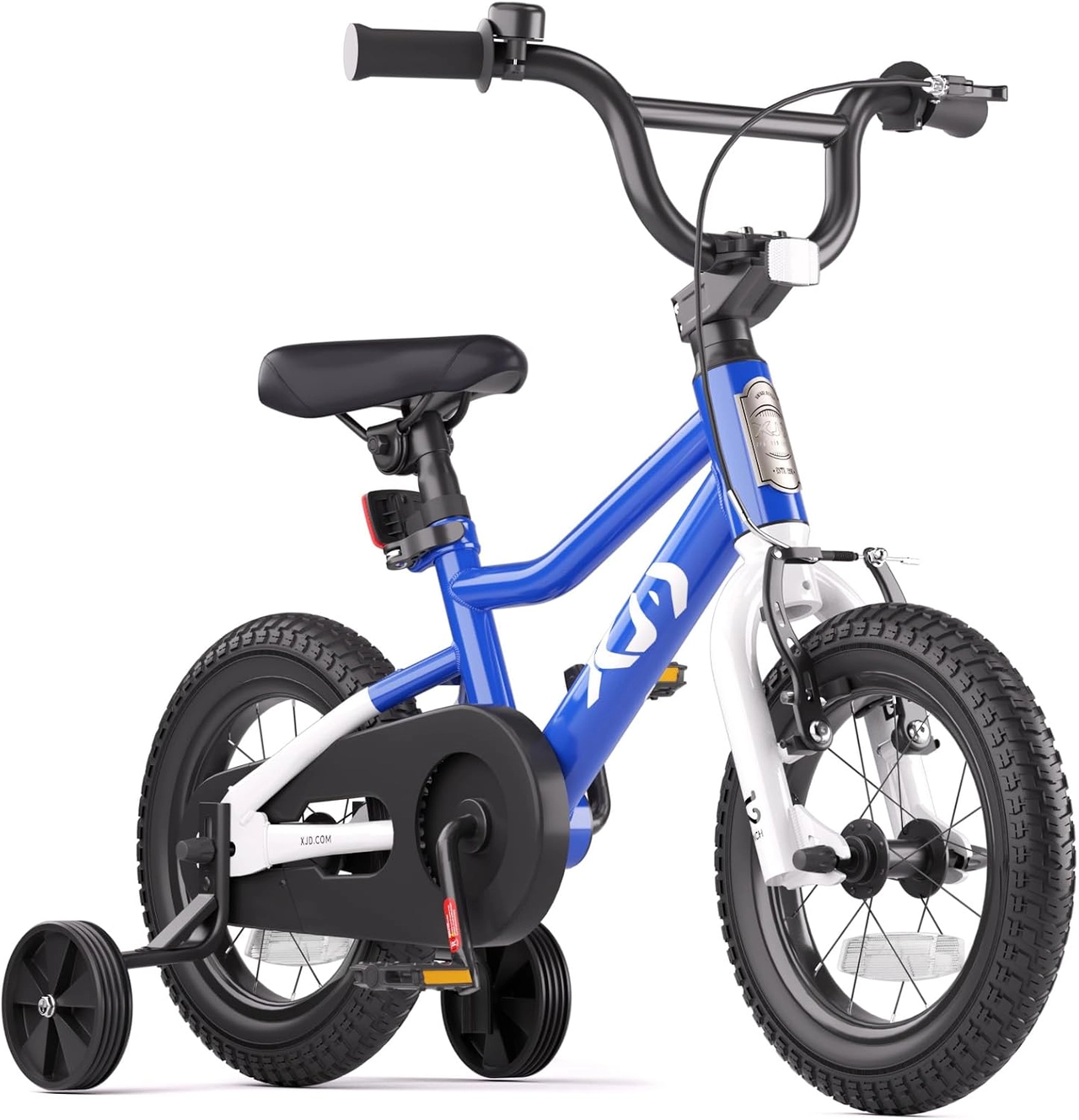
The Blue XJD training-wheel BMX family offers twelve, fourteen and sixteen-inch choices. Its catalogue does not specify a dish correction, spoke tension or measuring-gauge compatibility. If wheel service is required, ask for rim centering, trueness, tension and component condition to be considered together. Any disturbed wheel retention, rear coaster-brake equipment, front brake or learning supports need their own completed checks. Keep the actual service findings with the identified wheel rather than copying another bicycle’s target.
Model details relevant to this task
The linked Blue XJD learner provides a real small spoked-wheel context, with a single-speed drivetrain and front caliper plus rear coaster braking. The assembled merchant image is angled and cannot measure dish. No off-center condition, universal tolerance or need for a wheel adjustment is claimed from that photograph. The linked model details are available for XJD Kids BMX Bike with Training Wheels – Blue.
Quick checklist
- Identify hub contact faces.
- Separate dish from lateral true.
- Preserve the mounting arrangement.
- Confirm gauge size compatibility.
- Record complete wheel-service findings.
Common questions
Does a straight-looking rim prove correct dish?
No. Low sideways variation and centering relative to the hub contact faces are separate relationships.
Should I compare the exposed axle-tip lengths?
Axle tips are not the rim-centering reference described here. Identify the actual hub contact faces and measuring procedure.
Can a larger-wheel gauge be assumed to fit?
No. Confirm the tool’s supported wheel range and hub arrangement before relying on its reading.
Related collections
The small spoked learner BMX wheels and other training-wheel bicycle assemblies provide further model details. Check the exact selected configuration when planning fit, handling and care.
Before the next outing
Read kids bike wheel dish as an identified rim-to-hub relationship. Keep mounting, trueness and centering distinct, then use compatible measuring equipment and a complete wheel-service assessment when work is needed.