

First BMX Bike for a Child: Fit and Readiness Checklist
A child is ready for a first BMX bike when the bike fits today—not “next year”—and the rider can start, steer, brake, and stop without panic. Age can narrow the search, but height, reach, balance, and judgment are better final checks. This guide gives parents a practical way to evaluate fit and readiness before choosing a 20-inch kids’ BMX bike.
Start with fit, not the age printed on a box
Children of the same age can have very different proportions and riding experience. Begin with the manufacturer’s recorded range, then confirm the fit with the actual rider. For the XJD model featured below, the listed guidance is ages 7–12 and rider heights of 122–152 cm. Treat those numbers as a starting range rather than a promise that every child within it will fit.
When your child sits on the saddle, look for a relaxed upper body. The shoulders should not be pulled forward, the elbows should retain a slight bend, and the hands should reach the brake controls without an awkward stretch. The rider also needs enough clearance to get on and off confidently. If steering or braking requires the child to shift out of a stable position, the bike is not yet a good fit.
Use this BMX readiness checklist
A first BMX-style bike without training wheels is best for a child who already has basic two-wheel control. Before buying, watch the rider complete these simple tasks in a flat, traffic-free area:
- Start independently: The child can push off and place both feet on the pedals without needing an adult to hold the bike.
- Ride a straight line: The rider can look ahead instead of staring continuously at the front tire.
- Make controlled turns: The child can turn in both directions without cutting sharply or putting a foot down every time.
- Brake smoothly: The rider slows gradually, stops where intended, and understands that sudden braking can upset balance.
- Restart after a stop: The child can position a pedal and move away again without frustration.
- Scan the surroundings: The rider can notice people, pets, obstacles, and changes in the riding surface.
- Follow boundaries: The child reliably stops when asked and stays within the agreed practice area.
- Recover calmly: A small wobble does not immediately cause panic or a loss of control.
A child does not need perfect technique, but most of these skills should be consistent. If several are missing, more practice on a familiar pedal bike may be more helpful than moving immediately to a BMX setup.
What a 20-inch BMX setup changes
BMX geometry and tires can feel different from a neighborhood bike designed mainly for relaxed cruising. A BMX bike is commonly chosen for responsive handling and riding on pavement, pump tracks, parks, or compact dirt surfaces. That responsiveness is enjoyable for a capable rider, but it also makes good starting, braking, and steering habits important.
A single-speed drivetrain keeps shifting out of the learning process. The tradeoff is that the rider cannot select an easier gear for a steep hill. Think honestly about where the child will ride most often. Flat streets, paved paths, and beginner-friendly practice areas suit a single-speed setup better than long, hilly family rides.
“Without pegs” simply means stunt pegs are not included on the wheel axles. Pegs are not required for normal riding or for learning basic BMX control. New riders should build reliable balance, braking, cornering, and standing-on-the-pedals skills before considering tricks or additional equipment.
A real product example to compare
The XJD 20-Inch Freestyle BMX Bike without Pegs – Blue is listed as a 20-inch, single-speed BMX bike without training wheels. Its recorded fit guidance covers ages 7–12 and heights of 122–152 cm. The product information also identifies a high-tensile steel frame, U-brakes, and wide 20 × 2.4-inch tires. Use these facts to compare the bike with your child’s measurements, experience, and usual riding surface.
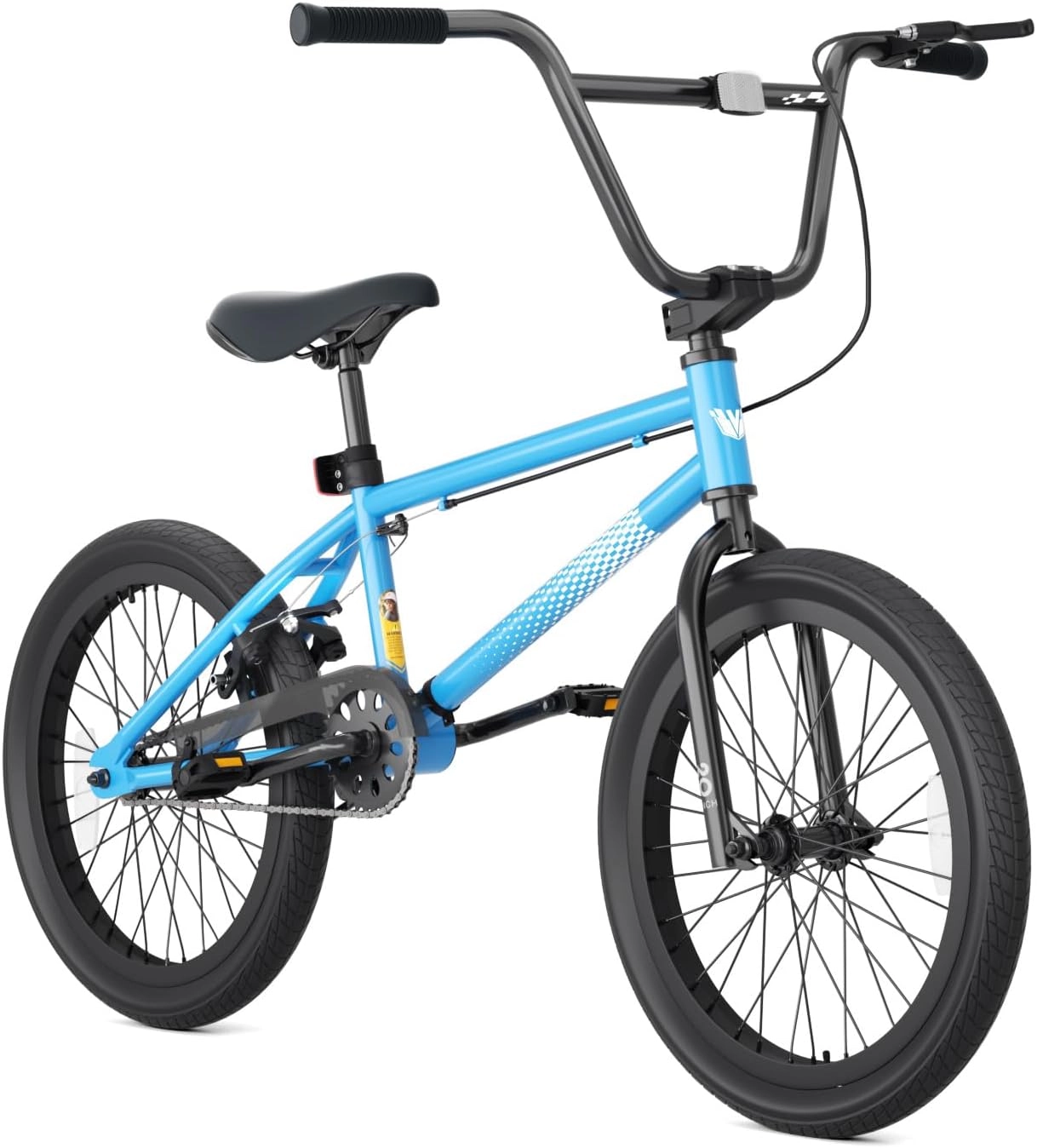
See the current images, availability, and configuration on the XJD 20-inch freestyle BMX bike product page. Recheck the live product details before ordering because availability can change.
Check controls and setup before the first ride
Assembly and adjustment affect safety as much as sizing. The selected XJD listing records easy assembly with an estimated time of 10 minutes, but parents should still follow the supplied instructions rather than rushing to meet a time estimate. If any step is unclear, use a qualified bicycle mechanic.
Before the first ride, confirm that the handlebar and front wheel are aligned, both wheels are secure, the saddle is correctly clamped, the tires are inflated within the marked range, and the brakes stop the bike smoothly. Spin each wheel and listen for rubbing. Check that pedals and other fasteners are secure. Repeat a short inspection before later rides, especially after transport or a fall.
Have the child practice braking at walking speed before riding faster. Begin on a dry, level surface away from traffic, driveways, crowds, and fixed obstacles. Progress to slopes or specialized riding areas only after the rider demonstrates predictable control.
Choose the practice environment carefully
The first sessions should be short and low-pressure. Mark a wide starting lane, a gentle turning point, and a clear stopping line. This gives the child one task at a time and makes improvement easy to see. Avoid introducing jumps, curbs, or crowded skatepark traffic during the first rides.
If the long-term goal is a pump track or BMX park, visit first without riding. Observe direction of travel, entry points, faster users, and posted rules. Select a quiet beginner period and keep early laps simple. Local facilities may require particular protective equipment or adult supervision.
Safety equipment is part of the fit
A correctly fitted bicycle helmet should sit level and remain secure when the child moves their head. Closed-toe shoes and clothing that cannot catch in the chain or wheels are sensible basics. Additional protection may be appropriate for BMX parks or more advanced riding, but protective gear does not replace supervision, a mechanically sound bike, or age-appropriate decisions.
Inspect the riding area for traffic, loose gravel, wet leaves, holes, and other hazards. An adult should supervise young riders and set boundaries that match their judgment and experience. Stop the session if the child becomes tired, upset, or repeatedly loses control.
Frequently asked questions
Is a 20-inch BMX bike right for every 7-year-old?
No. The featured product lists ages 7–12 and heights of 122–152 cm, but individual reach, leg length, coordination, and confidence vary. Confirm the child can mount, steer, reach the controls, and stop comfortably.
Does a beginner need BMX pegs?
No. Pegs are not needed for everyday riding or basic skill development. A bike without pegs lets a new rider focus on balance, braking, turns, and awareness.
Are training wheels necessary on a first BMX bike?
The featured model is listed without training wheels and is better suited to a rider who already has basic two-wheel balance. A child still learning balance may benefit from more practice on another appropriately sized bike before moving to this setup.
Can a single-speed BMX bike handle hills?
It can be ridden on some slopes, but it does not offer lower gears for easier climbing. Consider the steepness and length of local routes, as well as the child’s strength and stamina.
The practical decision
Choose a first BMX bike only after confirming three things: the rider fits the bike now, the child can control a two-wheel bike consistently, and the planned riding environment matches the bike’s setup. A measured, skills-based decision is more reliable than buying by age or appearance alone—and it gives the child a safer, more confident start.
Bikes for your next adventure
XJD 20-Inch Freestyle BMX Bike without Pegs – Blue
XJD 20-Inch Freestyle BMX Bike without Pegs – Blue brings the recorded fit, ridi…$189.99
XJD Kids BMX Bike with Training Wheels – Pink Blue
8 reviews
XJD Kids BMX Bike with Training Wheels – Pink Blue brings the recorded fit, ridi…$99.99
$119.99
XJD Kids BMX Bike with Training Wheels – Blue
8 reviews
XJD Kids BMX Bike with Training Wheels – Blue brings the recorded fit, riding an…$99.99
$119.99