

Training Wheel Bikes FAQ: 10 Questions Parents Ask
Choose a training wheel bike by measuring your child’s height, checking stand-over clearance, reach and brake control, then matching confidence to fit.
1. What should I measure before choosing a bike?
Measure the rider’s full height and inseam while they are wearing the shoes they normally use for riding. Height provides a wheel-size starting point; inseam helps you judge whether the child can stand over the bicycle comfortably. The final check must happen on the actual bike.
Also observe whether the child can reach the handlebar without stretching, steer while looking ahead and operate the brakes confidently. Age is only a rough guide and should never override these checks.
2. Which wheel size should I compare?
| Wheel size | Age starting point | Rider height |
|---|---|---|
| 12 Inch | 3–4 | 34–40 in / 86–102 cm |
| 14 Inch | 3–6 | 37–45 in / 94–114 cm |
| 16 Inch | 4–7 | 40–48 in / 102–122 cm |
| 18 Inch | 5–9 | 43–52 in / 109–132 cm |
| 20 Inch | 7–12 | 48–60 in / 122–152 cm |
| 24 Inch | 10–14 | 54–64 in / 137–163 cm |
| 26 Inch | Youth and adults | Over 60 in / 153 cm |
Overlapping ranges are intentional: two children of the same height may differ in inseam, reach and confidence. Compare plausible sizes, but choose only after confirming control on the complete bicycle.
3. Should I buy a larger bike for growth?
No. Do not buy an oversized bicycle merely to extend its useful life. A child who cannot stand over, steer or brake comfortably lacks effective control. Select a bike that fits now, while allowing only the adjustments described in its product manual.
4. How should the bike fit during a try-on?
Have the child stand over the frame and confirm comfortable clearance. Seated, they should reach the handlebar naturally rather than leaning or locking their arms. Ask them to steer in both directions and demonstrate that they can reach and operate the brakes.
A size-table match is not enough if the rider looks strained, cannot manage the controls or feels intimidated. Conversely, age alone does not rule out a size when measured height, inseam, reach and control support it.
5. How do confidence and ability affect the decision?
A cautious beginner may need a more immediately manageable fit than a confident rider of similar measurements. Training wheels support the bike from side to side, but they do not correct excessive reach, poor brake access or an oversized frame. Begin in a level, open area away from traffic and obstacles.
6. What should I compare among catalog options?
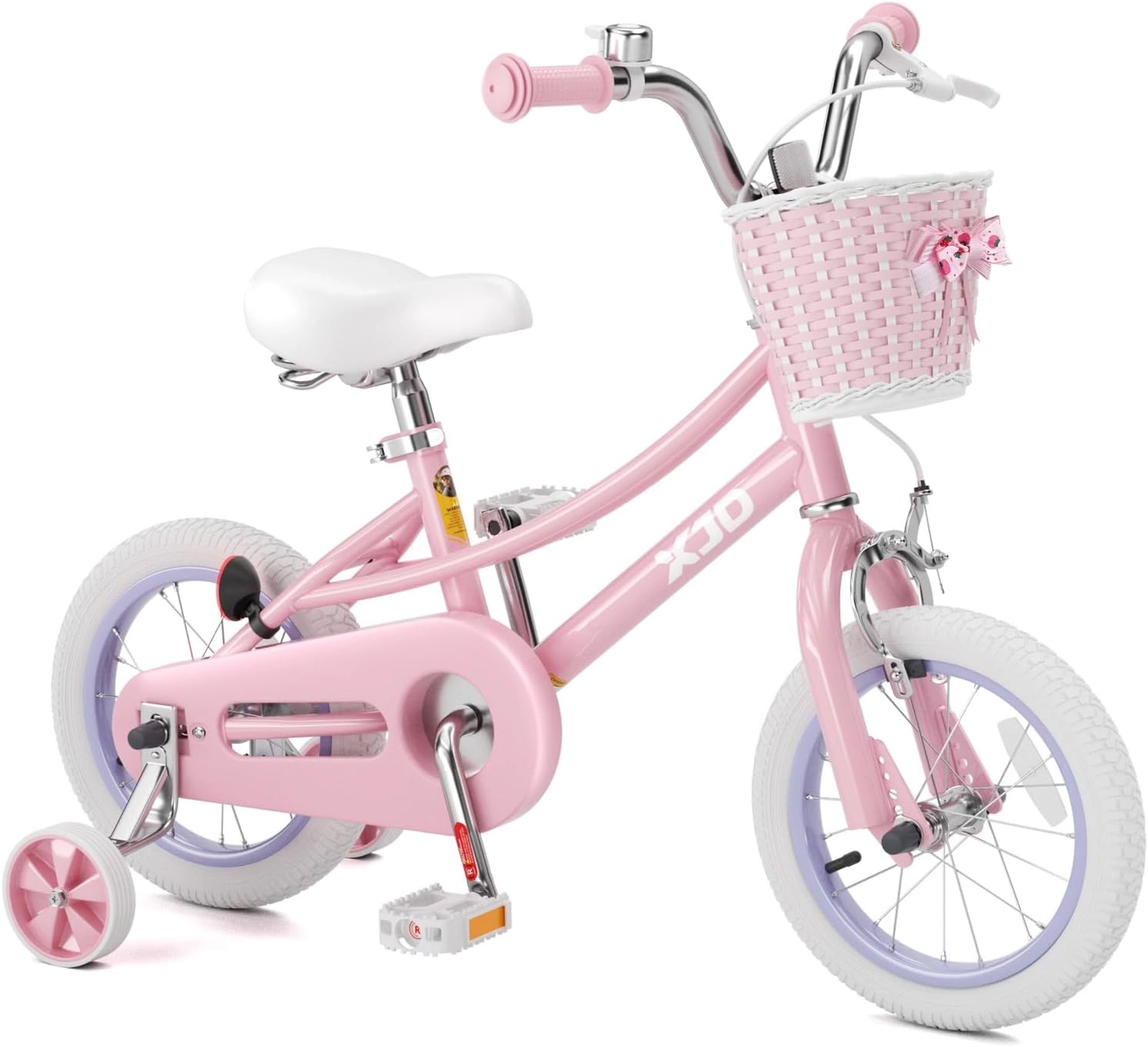
The XJD Girls Bike with Training Wheels & Basket – Pink is relevant because its catalog offers 12 Inch, 14 Inch, 16 Inch and 20 Inch labels. Those options let parents compare several supplied training-wheel-bike sizes against the measured-height starting points above. The catalog facts do not establish fit, so the child must still try the selected size and demonstrate stand-over clearance, reach and brake control.
7. What if my child’s likely size is 18, 24 or 26 Inch?
The supplied product does not list 18 Inch, 24 Inch or 26 Inch options. Its listed sizes are therefore comparison points only, not substitutes for a missing size. Do not assume that moving to 16 Inch or 20 Inch is equivalent to an 18 Inch fit, or that 20 Inch can replace 24 Inch or 26 Inch.
8. How should training wheels be set up and checked?
Use the exact product manual for assembly, training-wheel positioning, fastener checks, compatibility and any torque requirements. These details can differ by bicycle, and no universal number should be guessed. If the instructions are missing, unclear or inconsistent with the parts supplied, stop and ask a qualified bicycle mechanic.
Before each ride, look for loose, damaged or misaligned parts and confirm that the wheels and controls function as the manual describes. Do not ride until any uncertainty is resolved.
9. Does a child still need a helmet?
Yes. Training wheels do not prevent every fall or collision. Use a bicycle helmet that fits properly, sits level and has straps adjusted according to the helmet manufacturer’s instructions. Recheck the fit whenever the helmet is put on.
10. When are training wheels no longer useful?
Consider the next step when the child consistently starts, steers, brakes and stops with control and is ready to practice balance. Follow the bicycle manual before altering or removing components; if the procedure or compatibility is uncertain, use a qualified bicycle mechanic.
Your next action is simple: record height and inseam, shortlist only the matching wheel-size ranges, then have the child verify stand-over clearance, reach, braking and confidence on the actual training wheel bike.
Bikes for your next adventure
XJD Girls Bike with Training Wheels & Basket – Pink
23 reviews
XJD Girls Bike with Training Wheels & Basket – Pink brings the recorded fit,…$65.99
$75.99
XJD Girls Bike with Training Wheels & Basket – Purple
8 reviews
XJD Girls Bike with Training Wheels & Basket – Purple brings the recorded fi…$75.99
XJD Beach Cruiser Bike with U-Brake – Pink
3 reviews
XJD Beach Cruiser Bike with U-Brake – Pink brings the recorded fit, riding and c…$159.99